by Nick DiCicco
2025 was one hell of a year, and also a year whose existence created a tenth circle in Dante’s Hell. Both on a personal micro level and worldwide macro level, the midpoint of this decade has solidified itself as a confusing, insane, unprecedented time in what feels like the 7th year of tribulation.
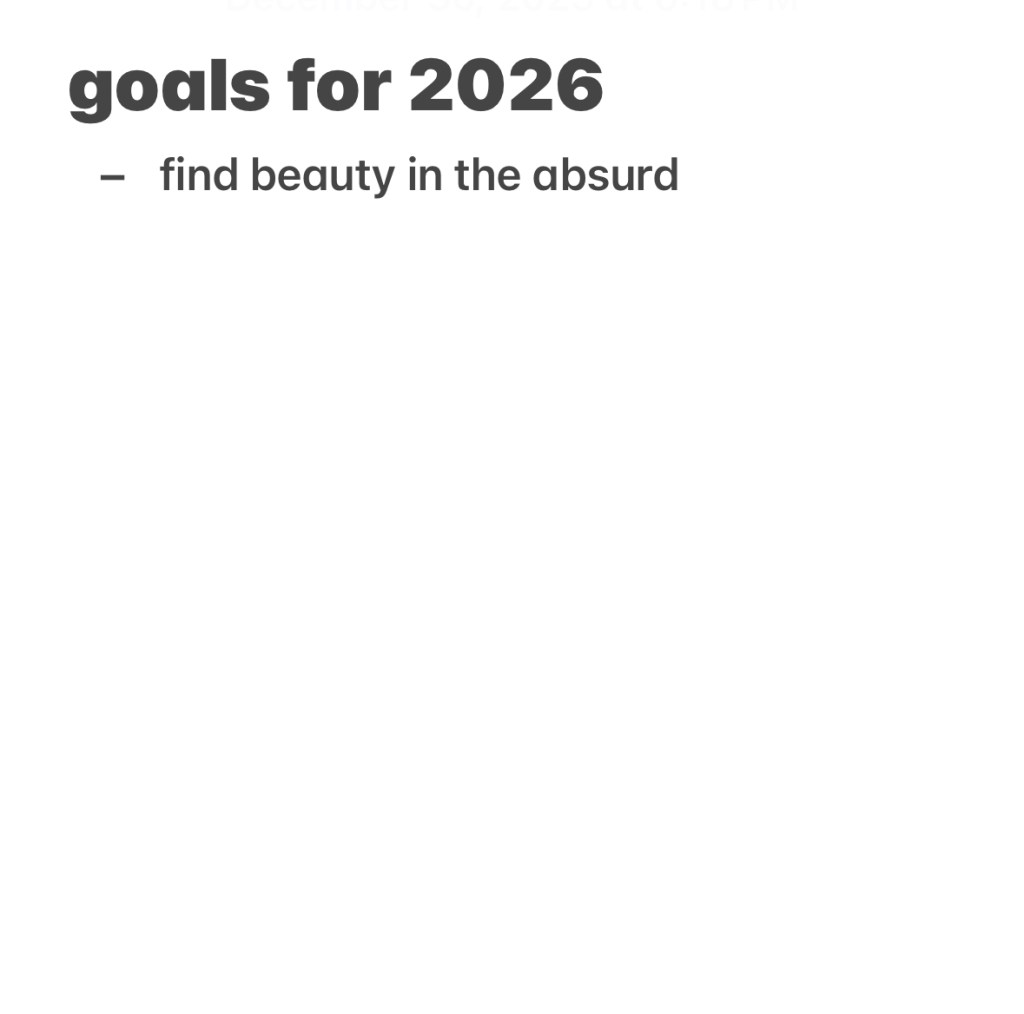
When I first decided I was going to finish the year with a reflective piece, all I could think to write about was the hardship and confusion that plagued me the past twelve months and the growth that came with it. Concluding the article and this year’s posts with a list of personal goals and potential growth for 2026 to hold myself accountable, I want to offer interesting pieces to keep up with throughout the year.
This is a worn-out task for me, however. As the moon reaches the tip of the sky, turning each December 31st to January 1st, I always feel a sense of hope for the new year, with a list of aspirations that at the exact same time the next year, I’ll be able to look back and be proud of my growth and loyalty to the superficial goals I made. But each new year, I tend to either not accomplish these goals, or if I do, focus on them for the first month of the year, but end in the same place I was, making the same tired plans.
Perhaps the biggest failure I make is that when I look back at the year, I only see the goals I did not accomplish but fail to consider the absurdity of life, and how with that absurdity come new accomplishments, evolved mindsets, and life experiences, which are often more important and impactful than whatever “personal growth” list I had made at the start.
As I look back at 2025, I certainly did not lose the weight I wanted to lose, did not go to the gym as much as I wanted to, did not stop the bad habits I wanted to stop, or “grow” in the way I thought I wanted to by becoming some “perfect” person. Instead, what I experienced was a beautifully broken year of anger, sadness, and rock bottoms, paradoxically filled with peace, happiness, and discovery.
While I could write a list of “10 things I learned and accomplished this year,” rather than bragging or sounding cliché, pretty much all can be summed up in two simple phrases: seek truth and embrace the absurdity.
Most people, including myself, would never admit to not seeking truth. I mean, nobody lives by the phrase, “seek lies.” Instead, we often settle for finding bits of truth in whatever our motives or beliefs already are to not make us feel wrong or uncomfortable. But, with the start of my college journey as a journalist, the first thing I learned is that it is my job to again seek the truth, no matter how uncomfortable or against my beliefs it may be.
It is impossible to seek truth without first opening up your mind to not only the idea that you may be wrong but also that all your past beliefs and all that you have known might be wrong. The truth is not loyal to political partisanship, religion, family, friends, or anything. The truth simply exists, and it is our job to seek it and live our lives accordingly. If you want to ignore the truth for a more comfortable life, that is up to you, but that does not mean fiction suddenly becomes fact.
This simple fact has changed my view of the world immensely this year. It has given me the privilege to research, learn, debate, and discover things about the world and myself, oftentimes taking me out of my comfort zone and confronting lies I’ve always believed. Opening my mind has made room for so much more empathy and understanding of others. When we remove the simple thinking that only what we believe is right, we make way for the ability to see and understand the multitudes of lifestyles and mindsets of 8 billion people who are also experiencing this life for the first time and trying to figure out what the hell to believe and how to live.
This leads into the second thing I learned this year—life is absurd, and that small unexpected things can alter our entire lives in mere seconds or completely by chance. There is little difference whether things are predetermined and happen for a reason, or if life is just a series of random events that piggyback off each other, giving us the illusion of free will.
I went into this year strongly believing that everything is predetermined to happen for a reason, but have left the year believing that everything happens, but it is our privilege to give it reason. Two very different mindsets, which can often result in the same conclusions.
Perhaps the clearest example of this comes from a person I met this year at a concert. One day, as she and I were discussing our beliefs on this very topic, the pure absurdity of the fact that she and I were talking took over my mind. I presented the insane chance that any of what had happened for us to meet had happened. First, the artist’s concert we were at was a fairly small artist whom my Spotify had happened to recommend to me months before, who I happened to listen to, happened to enjoy his music, and liked so much that I bought tickets for his concert, which he happened to be performing at in a city near my house on a night I happened to be free. Not only this, but all of this also had to have occurred for her as well. Furthermore, we happened to be standing next to each other, and she happened to have talked to me.
Now, with this way of putting it, it seems impossible for all of this to be a work of chance. Aesthetically speaking, it is much more appealing to have the mindset that we are meant to meet certain people or meant to accomplish certain things in life. However, as I kept thinking, I realized how with this sort of thinking, everything in life could be broken down to such an existential sense that everything must be predetermined, removing any sense of agency. And to me, that is where the idea, and even the aesthetic of fate was lost.
Rather than chalking everything up to fate, I think it’s alluring to see that all of our lives are filled with absurd and random occurrences, which we can then turn into some of the most beautiful connections and moments in life. This mindset has helped me not only deal with life’s unexpected moments but even the mundane daily tasks of being alive, and how, even though it is hard, it’s a privilege to have the ability to find the beauty and importance in small interactions and tasks.
With this expectation for unexpected and absurd events is where my hopes for 2026 come from. The other day, I was talking to someone I recently have grown close to, and she showed me her “2025 Bingo Card.” While I expected to see a cliché list of resolutions, what I instead saw was a card that featured small goals and adventures seemingly unimportant to one’s personal growth over a year. “Visit 5 national parks,” “have a no phone day,” “have 3 personal dates,” and “go to 5 concerts,” were just some of the goals she had for 2025. There were no huge physical or mental health goals, simply small adventures.
As I thought more and more about this list, I realized how these small objectives are not only enjoyable and obtainable, but also pave the way for bigger changes in one’s life than macro growth aspirations ever could. It is in these moments, whether it is time with nature, a day without using a phone, a personal date, or concerts, where the unexpected happens, where we meet new people, and where we discover new things that our mindsets change and growth naturally occurs.
This is exactly where all my growth for the year came from. In small day-to-day life decisions or adventures with my friends is where I made beautiful connections, opened my mind, and helped others. And going into 2026, I hope to do the same, not by creating a huge list of unobtainable goals, but by finding ways to grow and become better in the small daily tasks I create for myself.
 Nick DiCicco
Leave a comment